The Shugakuin Imperial Villa
| Photo |
Description |
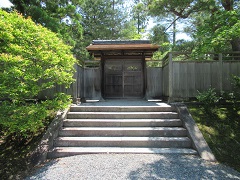 |
- Lower Villa, Miyukimon Gate
- The Miyukimon Gate with a shingled roof is decorated with the openwork curving of diamond-shaped flower crest.
|
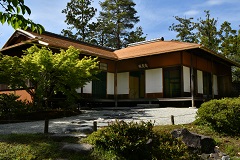 |
- Jugetsukan
- The Jugetsukan was the place where the Emperor Emeritus Gomizuno-o reposed himself before climbing to the upper villas. The present building was rebuilt in 1824.
|
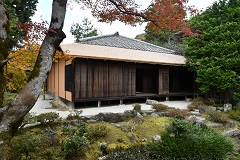 |
- Rakushiken
- Initially, the Rakushiken was built for the Princess Teruko, a daughter of the Emperor Emeritus Gomizuno-o.
- The Rakushiken pavilion was repaired. This was to repair the deteriorated parts of the shingled roof. The work was completed in October 2021.
-
https://sankan.kunaicho.go.jp/info/pdf/rakushiken-kouji.pdf(Open this content in a new window)
|
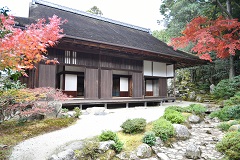 |
- Kyakuden
- The pavilion was moved from the Nyoin Palace of Tofukumonin (Consort of the Emperor Emeritus Gomizuno-o) in 1682. One of the two rooms, the Ichinoma contains a tokonoma alcove and a set of staggered shelves, which is called “Kasumidana (mist shelves)” because it resembles a mist floating. It is considered one of the three most treasured shelves in Japan, with the “Katsuradana” in the Katsura Imperial Villa and the “Daigodana” in Daigoji Temple in Kyoto.
|
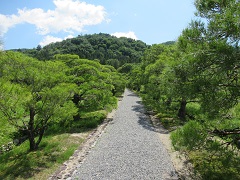 |
- Pine-Bordered Path
- The three villas are connected by the graveled paths lined with pine trees. The paths were constructed in the Meiji Period.
|
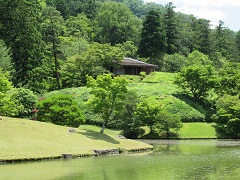 |
- Yokuryuchi Pond and Rinuntei
- In the Upper Villa, there is a large pond, called Yokuryuchi. Situated on the south bank of the pond, at the highest level of the Upper Villa, is the Rinuntei (meaning the Pavilion of Near-Cloud), where one could overlook the panoramic view below.
- The Rinuntei pavilion was repaired. This was to repair the deteriorated parts of the shingled roof, the plastered wall, and the furnishings. The work was completed in March 2022.
-
https://sankan.kunaicho.go.jp/info/pdf/rinuntei-kouji.pdf(Open this content in a new window)
|
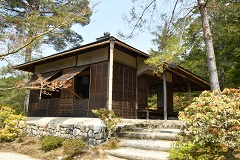 |
- Kyusuitei
- The Kyusuitei pavilion with a pyramidal shingled roof is situated in the highest level of the middle islet of the pond, which is the only building from the era that remains.
|
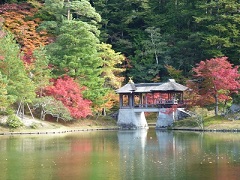 |
- Chitosebashi Bridge
- The Chitosebashi Bridge is a Chinese style stone bridge covered with an arbor. This was presented by Kyoto Shoshidai(the deputy for the governor-general of Kyoto) in the early 19th century.
|
 Learn about the Imperial Family